Showing posts with label Steamer. Show all posts

Sunday, September 3, 2017

Andes: The Ghost of the Loucinda

Time has glamorized paddlewheel riverboats, but some were anything but glamorous. The Andes was one of these boats that had a life of hardship and misfortune rather than romantic glamour. She went through several names and even more owners, and seemed to float from one mishap to the next. River folk can be rather superstitious, and this boat had her share of bad luck.


Originally built in 1897 by the Middleport, Ohio boatyard owned by Captain Benjamin Taylor Flesher, the 140-foot wooden-hulled sternwheeler was owned initially by the Carr Milling Co. and named the Speedwell. Carr (originally the Carr & Brown Milling Co.) was a flour milling concern in Hamilton, Ohio, on the Great Miami River, just north of where it joins the Ohio River. It is likely that Carr Milling thought that by owning their own riverboat, they could bring wheat in, and ship product out without be at the mercy of a shipping company. There is some indication that the boat also operated on another Ohio River tributary, the Kanawha.

Carr didn't keep the boat long, selling her in 1902 to Captain Sam Parsons who renamed her the Helen M. Gould (the wife of railroad magnate Jay Gould, who made a name for herself as a philanthropist) and began packet trade between Cincinnati and Portsmouth, and later between Louisville and Madison. The choice of the name was actually an odd one, as was the original. Sailors, including riverboat crews, are highly superstitious, and this trait extends to their captains. Having a name that begins with S (the worst-ever riverboat disaster happened to the Sultana) or contains the letter M is considered by some a sign of bad luck. For instance, the Greene family had boats named after just about every member of the clan, and yet no boat was named for the matriarch, Mary Greene (the only female captain on the Ohio), because of the M. That being said, the Helen's eight-year career with Parsons passed quite routinely, with only minor incidents occasionally occuring. Rivers, after all, are a dangerous place, even without superstitions.


In 1910, she was bought by the Lousiville and Cincinnati Packet Company, and completely rebuilt. When she emerged, she was essentially a new boat, other than keeping the Gould's engines, ten feet longer and had a new name, the Loucinda (derived from LOUiville, CINcinatti, iDianA). Now free of a name beginning with S or containing an M, things started going badly for the boat. Barely back in the water after her refit, on September 2, 1910, the Loucinda ran down an unattended launch three miles above Louisville, sinking it. Charges were pressed against pilot Gilbert Brasher for negligence and inattention to duty, and he lost his license. On October 12, 1912, a drunken passenger fell overboard and drowned, never a good sign to the highly superstitious riverboat crews. And that was just the beginning of her woes.


Then on April 25, 1913, Loucinda had a close brush with disaster. She had broken down at Louisville, Kentucky, and so the steamer Monterey was tasked with towing her to Jeffersonville, Indiana, for repairs. The Monterey was only half of the Loucinda's tonnage (107 to 197 tons), and when the pair pulled away from the warf, a south wind caught them and was more than the Monterey could handle, and the two were pushed into the main current of the river, heading straight for the Falls of the Ohio, a series of rocky rapids and waterfalls in which the river drops 26 feet, the only non-navigable part of the Ohio. The master of the Monterey tried to back towards the warf, but this just served to swing the pair so that they were now heading directly downstream. The Annual Report of the United States Life-Saving Service for FY 1913 describes what followed:
The power of the towing vessel [the Monterey] was not sufficient to offset the force of the current, and she was swept down through one of the openings between the Kentucky and Indiana chutes of the falls and over Backbone Reef.  In striking the reef she broke her rudder. She also started to leak from stem to stern, and filled so fast that her three steam pumps were unable to hold the inrushing flood in check. Passing under the Pennsylvania bridge, she was borne into the Big Eddy where the water in her hold set her to rolling. In a short time she turned entirely over and the fierce current tore away her upper works, letting her boilers and machinery drop out. Then the upturned hull floated off and plunged over the falls.
The danger in which the two vessels found themselves after leaving their warf was promptly observed from the life saving station. The service crew in two boats put out into the river and separated the line between them, then took off the five men composing the crew of the Monterey, and placed_them on the Loucinda. They next dropped an anchor from the vessel last named and carried two of her lines to the Indiana shore. With the lines firmly secured the men on the Loucinda slacked away on the anchor line and she swung into the quieter water near the bank. Later a harbor tug took her through the canal and on to Jeffersonville. Only two men were aboard the Loucinda.
In 1914, the Loucinda was chartered to the Louisville and Evansville Packet Company, but at some point during that summer, she hit a sandbar and became so stuck that she was not freed until that December when the river level rose. That many months without income was a difficult time for the steamer's operators.

The final and fatal bit of hard luck came three years later when, on January 30, 1918, she was wrecked in the Cincinnati ice gorge disaster that wrecked a number of riverboats. In the spring, the owners tried to salvage what they could. The hull was repairable, and in 1919 the Louisville and Cincinnati had a new boat was built on the hull, named the Andes. She was, but all reports, a bare-bones vessel, "cheaply built" according to one report. However, the bad luck seems to have been shaken off. She was even chartered off to the Greene Line for a time, and then sold, in March 1927, to Captain Oliver F. Bradford.

And then, on July 1, 1931, the good luck ran out. While approaching Plaquemine Lock, about 13 miles south of Baton Rouge, the Andes was wrecked and sank.


Sunday, February 26, 2017

The Hard and Unglamorous Life of a Towboat

In popular culture, the passenger-carrying paddlewheel riverboat ranks high in inherent romance. But passengers weren't the only portage to be carried on rivers: freight in large quantities, especially commodities such as grain and coal, were best carried on barges, and to propel the barges the paddlewheel "towing steamer" or "towboat" developed as a unique form as early as the 1860s, and lasted into the 1940s. They were the unglamorous trucks of America's inland waterways, little more than named freight locomotives on the water.  Around the turn of the century, there were upwards of 700 such towboats working America's western rivers. The Archive currently has three photos of towboats, the Junior, Gerard Klein and the H.P. Dilworth.

Despite their name, towboats typically pushed their loads of lashed-together barges (called a "tow"), rather than towing them. Because of this, they differed from passenger and freight riverboats in having a squared-off bow with large bumpers mounted on it. Well into the 20th century, stearnwheelers held an advantage over propeller-driven towboats, which needs a deeper draft and were more susceptible to damage. Eventually diesel power surpassed steam as it did on the nation's railways, and towboats are still the mucscle-men of the rivers today.

Junior

The Junior is listed in the Wooldridge Steamboat Listing as having been built in 1899, and the only other reference I've come across is a government report that says that, while navigating the Chicago River on October 12, 1909, "the steamer Junior was struck by the Rush Street Bridge when about halfway through the draw sustaining damage amounting to about $300."


H.P. Dilworth

The H. P. Dilworth was built in 1900 and was owned by the Dilworth Coal Company, who operated the Dilworth mine at Rice's Landing, a tiny borough in the southwestern corner of Pennsylvania, on the Monongahela River. H. P. Dilworth served on the Board of Directors for the mining company, and was the son of founder G. M. Dilworth.


Life was tough for a hard-working boat like the Dilworth. On August 13, 1904, the steamer suffered a collapsed lower flue in her starboard boiler near Homestead, Pennsylvania, which is also on the Monongahela. On February 2, 1907, the Dilworth was heading downstream on the river, pushing a lashup of coal-ladden barges (or "flats"; a typical load for the Dilworth was 10 to 14 flats) when it hit one of the piers of the Monongahela City bridge. The load broke loose, and two of the barges sunk. 


Just over two weeks later, at 3:50am on February 18, the boat was positioned under the Dilworth Mine's tipple to take on coal for her boilers...but the coal flowed from the tipple faster than the crew expected, and before they had realized it, the boat was overloaded and started to sink. The river was fairly shallow, and only the main deck was swamped. A double crew was onboard at the time, and though some had to jump overboard, no one was lost. Two weeks later, the steamer was refloated, repaired and put back into service. Finally, the Annual Report of the Supervising Inspector General, Steamboat Inspection Service to the Secretary of Commerce for FY 1911 includes this entry under the year 1910: 
January 19.—The towing steamer H. P. Dilworth, laid up at Rices Landing, Pa., with a watchman on board, caught fire about 10 a.m. from cause unknown and was totally destroyed. Estimated loss, $14,000.
While on fire, the boat broke free of her moorings and floated at least a mile down the river, which was running high, before finally sinking.

Today, only one steam-powered sternwheel towboat has survived on America's waterways, the W.P. Snyder Jr., which was retired in 1955 and sold for $1 to the Ohio Historical Society, and is on display at the Ohio River Museum in Marietta, Ohio.

Sunday, January 22, 2017

Portland's Last Great Steamboat Race

Once upon a time, during the heydays of steam riverboats in the 1800s, racing was a big deal. Most riverboats were operated as individual businesses, rather than by a line, and the Captain was usuallly the owner. Most operated regularly between city pairs, and there was usually fierce competition with the faster boat generally attracting the most paying passengers and freight. Rivalries were intense, and Captains would often schedule their runs to coincide with a competitor's boat, just to demonstrate that their's was the faster. Informal races were frequent, and the rivalries built to support more formal races as well. It was such a big deal that riverboat racing became a substantial part of riverboat lore, so quite naturally races were a thing to be remembered, and reenacted nostalgically, including one race on the Columbia River held 65 years ago this week between two notable sternwheelers.
Note the seaplane in the upper right corner

The Race

Thus in 1952, when the Jimmy Stewart/Rock Hudson motion picture Bend of the River was about to be released (release date was February 13th), a steamboat race on the Columbia River was staged as a publicity stunt. The film is primarily about settlers in the Oregon frontier, but a riverboat is featured as the means to bring much needed (and much fought-over) winter supplies to the settlement, so a riverboat race seemed to be an appropriate media-attracting event.
The Henderson (foreground) cuts cleanly through the water while the Portland plows through it.
The race, held on January 24, 1952, featured two sternwheel tug boats (rather than packet boats), the 51-year-old Henderson which had played the part of River Queen in the movie, against the Port of Portland's five year old sternwheel tug Portland. Several of the movie's stars, including Jimmy Stewart, were onboard the Henderson during the race, and Stewart's race narration was broadcast live by radio station KEX.  Because both boats were built as towboat/tugs, they were designed for heavy lifting, not speed, so that race didn't feature the kinds of speeds seen once-upon-a-time between packet boats, but nonetheless, it made for great publicity.

The 3.6-mile course was from St. Johns Bridge to Sauvies Island, and though the Henderson was favored due to the shape of her hull, she fell behind early in the race when she started loosing steam from a blown gasket in her high-pressure cylinder. The Engineer was able to shunt live steam directly to her low pressure cylinder, and with her wheel turning at 30 rpm, the Henderson came from behind to win the race by a full length-and-a-half.

The Henderson

The 159-foot Henderson was launched in 1901 as the M.F. Henderson, owned by Shaver Transportation, and was a combination towboat and freighter. The opening of the Cascade Locks in 1896 had opened up the Columbia from Portland to the Dalles for freighting, which created demand for new boats.

In 1911, the M.F. Henderson was towing a Standard Oil barge when she was rammed by the tug Daniel Kern, which was hauling rock barges. The M.F. Henderson capsized to her side in shallow water. Shaver had the steamboat dismantled, and rebuilt the following year by the Portland Shipbuilding Company, and renamed simply HendersonShe got a new locomotive boiler built by James Monk, providing twice the capacity as the old boiler, but kept her original single-cylinder engines, until in 1929 when the Henderson was re-engined with tandem-compound engines, adding low-pressure cylinders to increase her power and efficiency.

When President and Mrs. Warren Harding sailed from Tacoma to Alaska in the early 1920s, it was on the Henderson.  She later made a name for herself during World War II by handling over 5,000 ships on the Columbia and Willamette.


She sunk and was raised again in 1950. It was in December, as Henderson and the Diesel tug Chinook were moving the decommissioned steamship Pierre Victory from Portland to Tongue Point. While lashed to the starboard side of the Pierre, Henderson ran over some submerged pilings of an old Cottonwood Island dike, tearing a 20-foot gash in her wooden hull. Captain Sydney Harris had the tow line cast off, and Pilot Don Weik directed the rapidly sinking tug towards calmer water near the shore. The hole was later patched and the hull pumped out, refloating the Henderson.

By the time of the race, Henderson was one of only two wooden-hulled steamboats left on the Columbia. In December 1956, she was towing a grain ship near the mouth of the Columbia when Henderson encountered some large swells, which beat her hard against the hull of the bigger grain ship. Her old wooden hull failing, the Captain had no choice but to beach the tug. The derelict hulk sat on the river bank until it was burned in 1964 to salvage the scrap metal. The Henderson's wheel was saved by local boat builder John Hounsell who also restored it to its current condition on display at the Hood River Museum (a photo can be seen here).

The Portland

The Portland is a steel-hull tug launched in 1947 (replacing a predecessor of the same name), and holds the distinction of being the last sternwheel, steam-powered tug built in the US. Designed by Guy H. Thayer for the Port of Portland Commission, Portland was built in the Gunderson Brothers yard by Northwest Marine Iron Works. She had originally been intended to be a Diesel-powered, screw-driven tug, but the Columbia River Pilots Association insisted on the more traditional drive, believing that a sternwheeler would be better suited for maneuvering large ships within the narrow confines of the Willamette. At 219 feet long, the tug was powered by two single-cylinder horizontal non-condensing steam engines. Owned by the Port of Portland, she was operated for twenty years by Shaver Transportation, and then after 1966 by Willamette Tug & Barge. The insistance of the sternwheel propulsion turned out to be a wise choice.

Not long after losing the race to the Henderson, the Portland was called upon to help full a heavily-laden Standard Oil freighter off a sandbar on Sauvies Island. Other screw-powered tugs had tried and failed (the Henderson had also taken part in the effort). The Portland was secured to the S. G. Follis, and her wheel was put into reverse. It created so much wash that the sand holdng the Follis firm was flushed away and the freighter freed. Five years later, the Portland again did what other tugs couldn't. Two derelict ships had broken free from their moorings and had hit the Hawthorne bridge. Lodged there, the strain threatened to damage or even destroy the bridge. Again, other Diesel-powered tugs had tried and failed to budge the derelicts, but the Portland was able to tow them away and secure them.

In the 1960s, efforts were attempted by the Port Commission to replace the Portland with a newer, more efficient Diesel tug, but the regional pilots and ship owners were insistent that the sternwheeler had an important role to still play. However, twenty years later, the ships using the port had grown larger, and were now equipped with bow thrusters, so the usefulness of the unique Portland declined as her age increased. When the Portland was finally retired in 1981, she was the last steam sternwheeler tug in commercial service. The Port Commission didn't want to scrap her, and initially sought to convert her into a tourist excursion steamer. A lot of politics played into this, including some fairly strong objections from the Port of Cascade Locks, who owned and operated the modern-day purpose-built Diesel-powered tourist sternwheeler Columbia Gorge, ironically setting off a rivalry of sorts between the two boats that would manifest itself later.

After languishing for a decade, she was finally sold to the Oregon Maritime Museum for $1, intended to be a static display. However, there was so much interest in her - which translated into donated dollars - that a full operational restoration was possible. Today, she houses part of the museum and is open for tours at the Tom McCall Waterfront Park, and is operated occasionally at special events. Because of her distinctions, she is listed on the National Register of Historic Places.

In 2008, the 1952 race was supposed to be recreated as part of a Portland-sponsored civic event, "Sternwheeler Days and The Great Steamboat Race". Portland was to race her rival Columbia Gorge, but just before the race, the Portland suffered a mechanical fault to her steering system, and hit a bank, damaging her paddlewheel. Drifting without power or steering, she was headed for the Bonneville Dam before being secured by another tug. Since then, though, the two riverboats have raced three times, with the Portland taking the prize twice.

Sunday, December 18, 2016

Queen of the Rivers

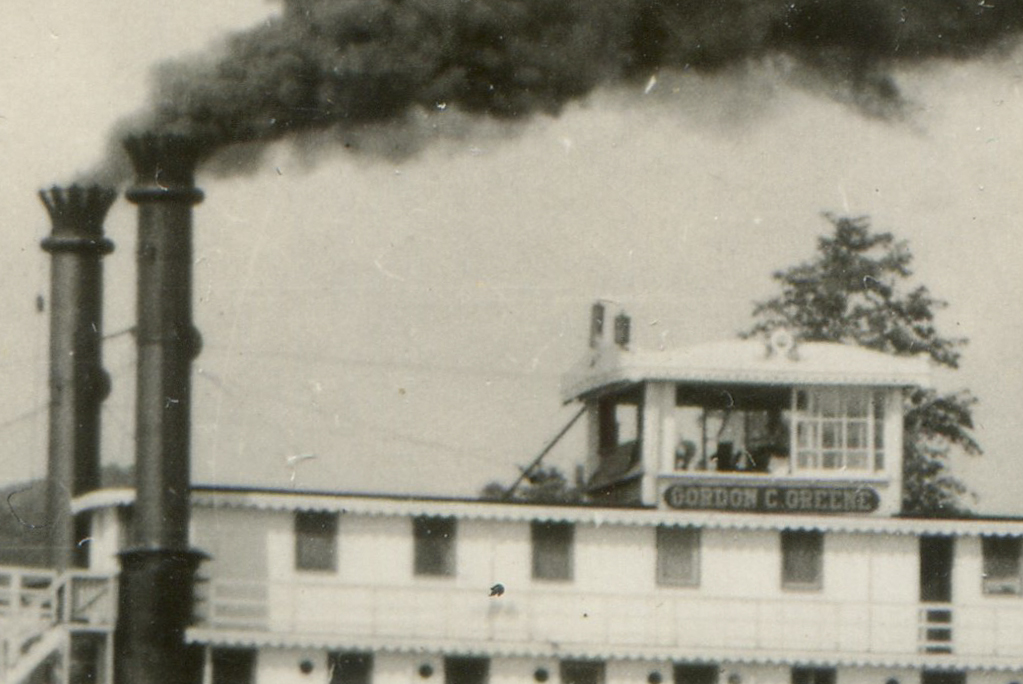
Steam-powered, paddle-wheeled riverboats were a mainstay on America's waterways for well over a century, and when the age came to a close, its nostalgic memory was carried on by a handful of large boats which managed to survive as tourist attractions into the mid and late 20th century. One of these was the celebrated sternwheeler Gordon C. Greene, which would live on to be an acknowledged queen of the rivers, as well as a movie queen.

The Gordon C. Greene in about 1939.

The boat had gone through a lot of changes in her life. Built as the Cape Girardeau in 1923 for the Eagle Packet Company, she was the last riverboat built by the Howard Shipyard of Jeffersonville, Indiana. The Cape originally only had three decks, with the main deck being mostly open. Eagle ran into tough times during the Great Depression, but Captain Tom Greene of the Greene Line foresaw business on the Ohio River improving, so bought the boat for $50,000 in 1935, with the intent of hauling tourists.


Tom came from a riverboating family. His father, Gordon Christopher Greene, started the business in 1890, the same year he married Mary Catherine Becker. Mary earned her riverboat master's and pilot's license, and was the only licensed woman steamboat captain on the Ohio River. Together, they had three sons, Christopher, Thomas and Henry, with the first to also becoming captains. Gordon had died in 1927, and Tom named the line's new boat after him.

To accommodate this new tourist role, Tom Greene started making some major changes to the boat over the course of the late 1930s. The upper deck on a steamboat is called the "texas deck", and was traditionally where the crew was housed. Later, with riverboats becoming tourist haulers rather than regular packet boats, the texas deck housed some of the premier passenger cabins.One of the first things he did was to add a second texas deck, first a fairly short one, then later lengthening it. In the promotional materials, Greene started referring to the upper decks not by their traditional name, but as "sun decks". He also enclosed, in phases, the main deck. These changes help fix the dates of old photos of the Greene, and the full second texas deck, plus the still-open section of the main deck suggest a 1939 date for this photo. The Greene was well marketed, and tourists from all over the US flocked to relive by-gone years on the river.


Of course, stardom in major motion pictures didn't exactly hurt the Greene's popularity. Her first appearance on the silver screen came in 1935's Steamboat Round the Bend, directed by John Ford and staring Will Rogers. Then came Gone with the Wind, in which the Greene plays the civil war era boat that Rhett and Scarlet travel on to their honeymoon in New Orleans.

After World War II, the tourist industry continued to grow unabated, and Tom saw more opportunity for expansion. When California's Delta Queen came up for auction in 1946 (it had been used by the Navy as a transport around the San Francisco Bay during the war), Tom Greene jumped at the opportunity to acquire and even larger riverboat. The Delta Queen was towed through the Panama Canal and up the Mississippi and Ohio rivers to Pittsburgh, where she was refurbished. In 1948, she entered service, displacing the Gordon C. Greene as the line's premier boat (and on April 22, 1949, Captain Mary Greene died aboard the Delta Queen just after departing New Orleans).


With the new queen on the rivers, the Greene began to show her age, and was retired in 1951, and in 1952 was sold to Portsmouth, Ohio, to be used as a floating hotel under the name of Sarah Lee. In 1955, she was moved to Owensborough, Kentucky and used as a restaurant and museum with the rather unimaginitive name Sternwheeler. Also in 1955, the old queen gave one more movie appearance, in The Kentuckian. In 1957, the boat appeared in another Clark Gable pic, Band of Angels.

When the museum failed, she was towed to Tampa, Florida to serve as a restaurant, and in 1960 moved to New Orleans to become a theater and bar. That lasted a whole year and she was sold yet again, this time to Hannibal, Missouri, as a restaurant named River Queen. That project, too, failed, and she was moved one more time, to St. Louis, Missouri, again to serve as a floating restaurant. The end came for the River Queen on December 3, 1967, when she sank at her moorings.

Parts of the old steamer were salvaged, and the rest was left to rot. On days when the water is running low, bits and pieces of her hull can still be seen.

For further reading and viewing: