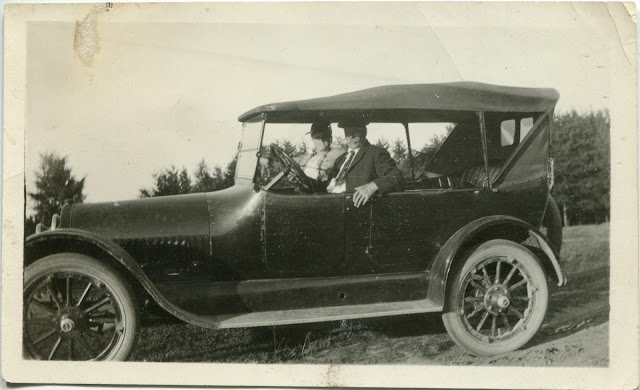
I found this photo buried in a stack at an antique store a while back...price: $1. The obvious resemblence to Teddy Roosevelt jumped out at me. As the lady working the cash register rang up my photo purchases, she saw the resemblence, too, and her eyebrows went up, then went up further when she realized I was getting the photo for a buck, and there wasn't anything she could do about it at that point!
So, is it Teddy Roosevelt? I think so, but can't be positive. It looks to me that they were on a family outing that day, enjoying what appears to be some nice spring-time weather Several of the women in photo look like women in Teddy's life, as well.
So what's your take? Teddy, or just a guy that looks like him?

Showing posts with label Automobile. Show all posts
Showing posts with label Automobile. Show all posts
Saturday, August 5, 2017

Monday, March 20, 2017
Mother, Daughter and the Spare Tire
I thought it a bit odd that this mother and daughter chose the spare tire to pose for. Maybe it had meaning, a story behind it? Maybe they'd actually had to change one?


Monday, March 13, 2017
A Classy Date in a Model T
All dressed up for a classy evening, including their shiny new1926 Ford Model T sedan.


Monday, March 6, 2017
A Couple and their Studebaker
For #MotorMonday, here is a proud couple out for a day in their Studebaker.

Monday, February 20, 2017
MotorMonday: The "Hot" Date
Imagine, if you will, the conversation between this man and this woman just now. It was supposed to be a romantic afternoon for this gal, riding in the country in her Beau's Ford Model T Roadster. He got all dressed up, bow tie and boots...then things got hot...for the automobile, at least. Yes, that's steam spewing forth from the radiator cap. And there they sit, she going on and on and on and he, just sitting there trying to make sense of how an afternoon which seemed so right went so wrong so fast. Ah, the joys of early water-cooled cars!
(Ok, nice story...but if it was a romantic date, who took the photo?)
(Ok, nice story...but if it was a romantic date, who took the photo?)
 |
| From what I can tell, this appears to be a 1927 or '27 Model T. |
 |
| Contrast enhanced to show that it is steam, not just a gap in the branches. |
Monday, February 13, 2017
Remembering the Hupmobile
Outside of hard-core classic car enthusiasts, few people have ever heard of the Hupmobile (I hadn't before researching this photo), so this really is a little bit of Lost America Found. I was having difficulty in identifying the car when I remembered rule number one: look at the back of the print, because sometimes, just sometimes, you get lucky and the photographer might have made a note. There, in light pencil, was written "Billie C. and our Hup." A quick scan through the manufacturers list at www.american-automobiles.com and Hupmobile popped out, and sure enough, there's a Hupmobile club with a pretty comprehensive website. This appears to be a 1924 or 1925 two-door sedan. I still don't, however, know who Billie C. was.

Robert Hupp, who had worked for Ford and Olds for a bit, partnered with his brother Louis to form Hupmobile and came out with their first car, the Model 20, in 1908. The company hit its stride in the 1920s, giving Ford and Chevrolet some decent competition. Hups generated a reputation for being reliable yet unpretentious. The Great Depression hit them hard, and to try to generate consumer interest, they turned to famed designer Raymond Lowrey for a couple of designs, but to no avail, and with resources becoming scarce at the beginning of WWII, the company folded.

Robert Hupp, who had worked for Ford and Olds for a bit, partnered with his brother Louis to form Hupmobile and came out with their first car, the Model 20, in 1908. The company hit its stride in the 1920s, giving Ford and Chevrolet some decent competition. Hups generated a reputation for being reliable yet unpretentious. The Great Depression hit them hard, and to try to generate consumer interest, they turned to famed designer Raymond Lowrey for a couple of designs, but to no avail, and with resources becoming scarce at the beginning of WWII, the company folded.
Monday, February 6, 2017
Double Date to a T
There's nothing like a drive in the country in a way that couldn't be done just a few years before: in the convenience of a convertable Model T Touring Car! The car appears to be somewhere between a 1920 and 1922 year model.


Monday, January 30, 2017
Car Trip to the Beach
What a better use for that new invention called the automobile than to pack up the kids and head for a day at the beach? Because this photo is a bit blurry, I'm not certain of the car's make/model, but the windshield shape is remniscent of a pre-1920 Studebaker, and the radiator badge appears to be an iron cross. Any suggestions? Please comment below!


Monday, January 23, 2017
MotorMonday: Golden Eagle Gasoline
Golden Eagle appears to have been a California brand of gasoline from the 1930s, which explains the lack of a canopy for this gas station that sits in the median of a street (the automotive blog The Old Motor also has a photo of a Golden Eagle sign in SoCal). And check those prices!


Monday, January 16, 2017
A Cadillac Just Like Al Capone's
Despite the poor-quality camera work in this photo, the car shown was, for its day, top of the line, the Cadillac 341, which explains why the owner likely wanted his photo taken in his shiny new status symbol (the fact that it's crooked and cuts off the front suggests that he set the camera up on something nearby and shot using the self-timer).

Cadillac built it's superior reputation early on by emphasizing precision machining and manufacturing, which resulted in cars that were more reliable than their competitors, and more expensive. It was a pricey car for the era: list price before extras for the 1928 model was $3,395, in a year when the average American's salary was $1,490, and the median cost of a new house was $4,250. There was little external difference between the 1928 and 1929, but from what I can tell, the one shown in our photo is a '28. (More on the 341 Series can be found here.)
The Chicago police department used the 341 as squad cars, so when famed gangster Al Capone picked a car to be modified and armored, the 341 was a natural choice - he even had it painted in the same two-tone green that the cops used. (It can be seen here.) Having been shot at several times by members of the rival North Side Gang, Capone spared no expense in equipping his 341 with steel armor and inch-thick bullet-proof glass. It was sold at Sotheby's in 2012 for $341,000 (it should be noted that persistent rumors that this same 341A was used by FDR in 1941 are false; Capone's car was in England at that time). In 1933, the British Pathe newsreel service filmed a walk-around tour of Capone's highly-modified 341 Town Sedan, and it has been digitized on YouTube:

Cadillac built it's superior reputation early on by emphasizing precision machining and manufacturing, which resulted in cars that were more reliable than their competitors, and more expensive. It was a pricey car for the era: list price before extras for the 1928 model was $3,395, in a year when the average American's salary was $1,490, and the median cost of a new house was $4,250. There was little external difference between the 1928 and 1929, but from what I can tell, the one shown in our photo is a '28. (More on the 341 Series can be found here.)
The Chicago police department used the 341 as squad cars, so when famed gangster Al Capone picked a car to be modified and armored, the 341 was a natural choice - he even had it painted in the same two-tone green that the cops used. (It can be seen here.) Having been shot at several times by members of the rival North Side Gang, Capone spared no expense in equipping his 341 with steel armor and inch-thick bullet-proof glass. It was sold at Sotheby's in 2012 for $341,000 (it should be noted that persistent rumors that this same 341A was used by FDR in 1941 are false; Capone's car was in England at that time). In 1933, the British Pathe newsreel service filmed a walk-around tour of Capone's highly-modified 341 Town Sedan, and it has been digitized on YouTube:
Monday, January 2, 2017
Four Ford Model Ts
For #MotorMonday, we offer four unrelated photos of people proudly displaying their Ford Model Ts.
First up, below, is a Runabout roadster with 1922 California license plates. The 1922 year model was a continuation of the previous year, which had introduced all-new body features. In 1922, one of these little numbers would have set you back a whopping $269...and for an extra $70, they'd add the optional starter! Ford built 160,000 roadsters in 1922.

 This gentleman on the right is enjoying life behind the wheel of his 1925 four-door sedan. The product line hadn't seen any major changes since 1923, but subtle details suggests the 1925 year model. Equipped with an electric starter as standard, this five-passenger model cost $680...but keep in mind that median income was about $1,400 (by comparison, the median US income in 2015 was 55,000, so percentage-wise, this equates to a 26,000 car).
Model Ts were tough cars and stayed around. Though the photo below was taken in 1932, the car is either a 1922 or 1923 four-door touring car. Note that the top has been removed completely. Chas. Martin looks fairly young, so it's a fair bet that this used car is his first one, hence the occasion for a snapshot.
 Lastly, this guy is assuming quite the pose with his Model T. License plates are from 1944 (and Model Ts were last produced in 1927).
First up, below, is a Runabout roadster with 1922 California license plates. The 1922 year model was a continuation of the previous year, which had introduced all-new body features. In 1922, one of these little numbers would have set you back a whopping $269...and for an extra $70, they'd add the optional starter! Ford built 160,000 roadsters in 1922.

 This gentleman on the right is enjoying life behind the wheel of his 1925 four-door sedan. The product line hadn't seen any major changes since 1923, but subtle details suggests the 1925 year model. Equipped with an electric starter as standard, this five-passenger model cost $680...but keep in mind that median income was about $1,400 (by comparison, the median US income in 2015 was 55,000, so percentage-wise, this equates to a 26,000 car).
Model Ts were tough cars and stayed around. Though the photo below was taken in 1932, the car is either a 1922 or 1923 four-door touring car. Note that the top has been removed completely. Chas. Martin looks fairly young, so it's a fair bet that this used car is his first one, hence the occasion for a snapshot.
 |
 Lastly, this guy is assuming quite the pose with his Model T. License plates are from 1944 (and Model Ts were last produced in 1927).
Monday, December 19, 2016
The Family's New Chevrolet
This whole family seems absolutely thrilled with the wonderful new four-door touring Chevrolet 490 that Dad has just brought home. Of couse, if you look close, it doesn't appear to be brand new, just new to them. This is most likely a 1921 model. The 490 was built from 1915 to 1922 and was Chevrolet's answer to the Ford Model T; the model number came from the initial sticker price of $490 (though it didn't stay that price for long, soon more than doubling!).


Monday, December 12, 2016
Indian Gas Introduces Texaco Ethyl
It is 1931, it's been raining, the unpaved roads are a quagmire of mud, and this guy needs some gas, so he pulls into the local Indian Gas Station to fill up on the latest in new gasoline technology, Texaco's Ethyl.

Indian Refining had been a major player in the gasoline and oil markets since 1902, but on January 14, 1931 the Texas Corporation gained controlling interest in Indian and soon began infiltrating its branding. Texas, under their Texaco brand, had introduced Ethyl gasoline in late 1930, and the acquisition of the Indian stations gave Texas a new outlet in the Midwest to sell this new and improved gasoline formula. It is rebranded "Texaco Fire Chief" in April 1932, so there was only a relatively small window when this photo could have been taken.
Ethyl, by the way, is the snazzy branding of the lead in leaded gasoline (technically, it is tetraethyl lead, or TEL). We have Unleaded gasoline today because of the rather nasty cumulative effects of lead building up in the environment. But they didn't know such things back then.

Indian Refining had been a major player in the gasoline and oil markets since 1902, but on January 14, 1931 the Texas Corporation gained controlling interest in Indian and soon began infiltrating its branding. Texas, under their Texaco brand, had introduced Ethyl gasoline in late 1930, and the acquisition of the Indian stations gave Texas a new outlet in the Midwest to sell this new and improved gasoline formula. It is rebranded "Texaco Fire Chief" in April 1932, so there was only a relatively small window when this photo could have been taken.
Ethyl, by the way, is the snazzy branding of the lead in leaded gasoline (technically, it is tetraethyl lead, or TEL). We have Unleaded gasoline today because of the rather nasty cumulative effects of lead building up in the environment. But they didn't know such things back then.
Monday, December 5, 2016
Motor Camping
With the newly popular automobile came motor camping, the car becoming part of the tent, to the delight of these ladies out "roughing it". Though mostly obscured, this appears to be an early 1920s Ford Model T Touring car.


Monday, November 28, 2016
The Boys and their Willys Woody Wagon
It's 1959 or '60 (it says "60" on the Utah license plate, if you look close), and someone's having fun with their new Willys Wagon!

To see what one looks like in color, check out the photos in this Willys forum thread.

To see what one looks like in color, check out the photos in this Willys forum thread.
Monday, November 21, 2016
Terraplane of 1935
The Terraplane was a automobile brand build and sold by the Hudson Motor Car Company between 1932 and 1938. Our photo today for #MotorMonday is a shiny, new 1935 Terraplane sedan being proudly displayed by its owner. The Terraplane model was intended to be a durable but low-cost consumer offering, but was generally underpowered, so didn't achieve the market popularity Hudson had hoped for. The slogan Hudson used in its marketing was "On the sea that's aquaplaning, in the air that's aeroplaning, but on the land, in the traffic, on the hills, hot diggity dog, THAT'S TERRAPLANING"


- A detailed history of Terraplanes can be found here.
- How a rare one was found and restored can be found here.
Monday, November 14, 2016
MotorMonday: Pan-Gas Filling Station
When automobiles started to appear on American streets, so did businesses needed to fuel them. Today's photo shows a filling station from one of the largest oil companies in America at the time. Sadly, portions of our print were devoured by a hungry rodent at some point, obscuring the view of the pumps.

In the early teens, automobile sales started to rise and the "horseless carriages" became more than just a curiosity, they became a practicality. They also presented a demand for fuel, and businesses were quick to respond. Initially, all sorts of stores and other businesses installed pumps and sold gasoline. In 1914, though Standard Oil of California took a different approach and sought to streamline the marketing and distribution of gasoline, opening a chain of 34 gasoline stations up and down the west coast. Other chains quicky copied the idea and opened their own "filling stations".
Oil baron Edward L. Doheny had made his fortunes drilling for and finding gushers down in Mexico, and in 1916, incorporated Pan American Petroleum as a parent company for his Mexican interests. The company promoted its gasoline initially as Pan-Gas, and its motor oil products under the Pan-Am name. Later gas stations dropped "Pan-Gas" and settled on Pan American.
Doheny expanded his empire into Central America, and by 1921, Pan American was the largest petroleum company in the United States. In 1922, however, Doheny and Pan American became embroiled in the Teapot Dome scandal, wherein Interior Secretary Albert Fall was accused of taking bribes from oil barons in exchange for granting leases outside of the competitive bidding process. Fall went to prison and the debacle was considered the most sensational political scandal until it was overshadowed by Waterdate a half-century later. Eventually, Doheny was cleared of all wrongdoing.
Over the next several decades, Doheny continued to build his empire, buying and selling properties, often dealing with Standard Oil of Indiana. Eventually, in 1954, Pan American and Standard of Indiana decided to merge and formed Amoco.

 |
| Pan-Am oil products on display in the window. |
Oil baron Edward L. Doheny had made his fortunes drilling for and finding gushers down in Mexico, and in 1916, incorporated Pan American Petroleum as a parent company for his Mexican interests. The company promoted its gasoline initially as Pan-Gas, and its motor oil products under the Pan-Am name. Later gas stations dropped "Pan-Gas" and settled on Pan American.
 |
| Hughes Ice Cream may be a clue as to the photo's location: The only references I could find were to a company by that name based in Lexington, KY. |
Over the next several decades, Doheny continued to build his empire, buying and selling properties, often dealing with Standard Oil of Indiana. Eventually, in 1954, Pan American and Standard of Indiana decided to merge and formed Amoco.
Monday, November 7, 2016
Road Trip: Two Families and a Studebaker
I'm having a hard time deciding whether this series of photos depicts two families on a vacation trip, or moving in search of a better situation. They have an awful lot of stuff loaded on to their Studebaker, which appears to be a 1918 model.


 |
| So how are the families related? Two sisters? Two brothers (assuming the photographer is the other husband)? Think about it: eight people (four of them restless children) crammed in that automobile! |
 |
| That looks like a mattress tied on to the side of the car with all the other luggage, as they complete a river crossing on board a cable ferry, or punt. A horse and buggy wait behind them. |
 |
| It's too bad that the license plate is obscured by the bumper...it would have been interesting to be able to see the state and possibly year on it. |
Thursday, November 3, 2016
Girls and Pick-Up Trucks
The first #TBT of every month dedicated to our love affair with our cars and trucks.
I saw a bumper sticker the other day on the back of a big 4x4 pickup that said "Silly boys, trucks are for girls!" And, it seems, that's a very old sentiment, as far back as when pickups were new.

I saw a bumper sticker the other day on the back of a big 4x4 pickup that said "Silly boys, trucks are for girls!" And, it seems, that's a very old sentiment, as far back as when pickups were new.

Thursday, October 6, 2016
A Stop in Bishop
For those not familiar with eastern California, you might not have heard of the little town of Bishop. It is a unique place, sitting at the northern end of the Owens Valley, the gateway to the eastern Sierras. Bishop has a history steeped in mining and mountaineering. John Muir used to come though upon occasion. It is a watering hole on the way to Mammoth Mountain, Mono Lake and points north. For hunters and fisherfolk, hikers and climbers, it is a place to eat and fuel before heading into the back country.

So what's this gentleman doing? His truck appears to be loaded up...is he heading for a mining operation? A camp?
Subscribe to:
Posts (Atom)