The log cabin construction, the tree-trunk porch posts, the 1890s clothes, this is one interesting family gathering photo.
Showing posts with label Architecture. Show all posts
Thursday, February 15, 2018
Thursday, January 18, 2018
Our House - 16
Thursday, December 21, 2017
Our House - 15
This is a huge house for era, and judging by the folks on the porch, one set of grandparents lived with this family.
Thursday, November 16, 2017
Our House - 14
It is a bit harder to get a sense of the architecture with this family photo. It's probably the 1920s, and the trim on the porch is intriguing.
Thursday, October 19, 2017
Our House - 13
This month's "Our House" photo is another very faded albumen print from the 1880s or 1890s, and depicts an elderly couple (the husband is wearing styles from the 1870s) posing in front of their home. Note the gingerbread decorative touches at different places on the house...someone clearly put a lot of labor into this place.
Thursday, September 21, 2017
Our House - 12
House portraits typically feature the whole family, so where it the husband in this one? Since such photographs were typically shot by traveling photographers who went door-to-door at time when the whole family could be expected to be home, maybe the husband was simply away on business. This print is broken, with the lower left corner being found in a whole separate bin in the antique store, and then rejoined digitally in photoshop.
What I find most curious about this photograph, though, is the unusual windwheel which appears behind the house and above the roofline (below). This appears to be a Dempster Vaneless model, inwhich the sectional blade segments collapse as wind speed changes in order to regulate the mill's speed. A good video that describes and shows this type of windmill in operation can be found here on YouTube. A restored one can be found at this web page.
Thursday, August 17, 2017
Our House - 11
So, I have to wonder with this photo: what was the point of hauling such a beautiful rocking chair out into the yard if no one was going to sit in it for the photo? Maybe it's in memorial to someone who recently passed? Maybe the husband of the woman sitting in the other chair? And I wonder why the son chose to stand behind the fence, instead of with the rest of the family? Given the wife's dress style (specifically the puffed sleeves at the shoulder), I'd guess this was taken in the 1890s.
Thursday, July 20, 2017
Thursday, June 15, 2017
Our House - 9
As soon as I saw this photo in a pile in an antique store, my eyes popped...such amazing brickwork! They certainly don't build houses like this today.
Sunday, May 21, 2017
The New Fire Hall
This real photo postcard was written but not postally mailed, and the text on the back includes "The New Fire Hall". Someone, much latter, added "NY", so presumably they new this was in New York (state, or city?) somewhere.
In the lower right of the photo is the for-sale sign shown below, but unfortunately, despite high-resolution scanning, the resolution of the original photo just isn't quite good enough to make out the street address of the realtor, which might then help locate the photo.
Thursday, May 18, 2017
Our House - 8
This is a delightfully beautiful Victorian gingerbread...I only wish I knew where it was! Clearly this was built when manual labor was cheap but still carried great pride in craftsmanship.
Sunday, April 23, 2017
Updike Grain Co.
This old photograph, produced by the "Lake View Studio" (where that was, I have no clue), of an Updike Grain Company elevator sent me on a very unexpected journey, exploring some of the fierce legal and political battles brought on by federal government meddling in the markets that wracked the grain farming industry at the time of the Great Depression.The Updike Grain Co. was a large grain storage and trading company, headquartered in Omaha, Nebraska, and which operated grain elevators throughout the mid-west. Nelson Blackwell Updike (b. Dec. 2, 1871 Pennington N.J.) first bought a grain elevator in Eldorado Neb. shortly after his marriage in 1895. With the success of that elevator, he began to purchase more country elevators, and built terminal elevators in Omaha. He incorporated the Updike Grain Corp. in Omaha in 1899, and became a member of the Chicago Board of Trade's grain exchange in 1900. In 1903 Updike helped found the Omaha Grain Exchange with several other local grain company owners.
When the Union Pacific Railroad tried to use a tariff rule loophole to deny payment for grain storage to Updike and several other companies, Updike sued, and the case made it all the way to the U.S. Supreme Court. The judgment was decided on December 4, 1911 in favor of Updike, with Justice Lamar writing the opinion of the court.
![]() |
| Nelson B. Updike, from the 1922 edition of the Official Reference Book, Press Club of Chicago |
In the 1920s, farmers were hard-hit by wildly fluctuating market prices, driven by commodities speculators. This resulted in Congress passing the Grain Futures Act in 1922. As the nation's economy started to implode in the late 1920s, Congress also passed the Agricultural Marketing Act which established the Federal Farm Board, commissioned to stabilize commodities prices and thus halt the downward spiral of grain prices which threatened to ruin America's farmers. The effort was largely a failure.
In order to take advantage of price subsidies, the Farm Board required farmers to join production cooperatives, and in 1929 established the Farmers National Grain Corp, a quasi-public, government-funded entity described in court documents as an "association of cooperative associations". Rather than building an extensive infrastructure of its own to facilitate national trade in grain by the member cooperatives, FNGC purchased existing companies, including in 1930, the Updike Grain Co. This purchase, allegedly done secretly, brought two important assets to FNGC: its large chain of grain storage elevators like the one shown in our photo, and its seats on the Chicago Board of Trade and the consequent membership in the grain exchange (more on this in a bit).
That same year, the Federal Farm Board and FNGC established the Grain Stabilization Corp. in order to protect farmers from wildly swinging grain prices brought on by speculators and commodities traders. The Board was Pres. Herbert Hoover's method of establishing a means of federal regulation of crop prices. GSC was run by farmers' cooperatives, but fully funded by the Farm Board (meaning the government). To increase farmers' income, the GSC was allowed to buy and sell grain on the open market, with FNGC acting as its broker, and it set out to corner the market on grain, buy up any surpluses, and thus drive up the prices. This created a raft of unintended consequences (some of which are discussed in this article), and by 1933, with the nation deep in the Great Depression, the Farm Board decided that it had helped the farmers as much as it could, and GSC's stockpile of grain was slowly sold off. This was completed by April 29, 1933.
The adversaries of the scheme was The Chicago Board of Trade, which was described by Rep. Strong in 1932 as "the world's greatest wheat gambling rendezvous." (Chicago Tribune, May 25, 1932). Politics created a fair amount of enmity between the government and Farmer's National and the Chicago Board of Trade's grain exchange. Updike had been a member of the exchange since 1900, and its executives held two board seats, and FNGC used Updike's membership to clear its trades.But in 1931, the Board of Trade changed its rules to exclude government owned and subsidized concerns, and Updike's membership was suspended. Charges flew that this was the traders' attempt to undermine the coop and price stabilization movements (with stabilization, speculators can't easily manipulate the market and make their huge profits). The Board of Trade decided that for a company to trade on the exchange, it had to have at least two company executives on the board, and they could only be members if they owned stock in their company. Because the two Updike executives no longer owned stock (since it was now a wholly-owned subsidiary of FNGC), they were thrown off the board. The rules by which FNGC was established stipulated that its stock could only be owned by farmers' cooperatives, and not by individuals, so this excluded FNGC from joining the board and the exchange under its own name. Without membership in the exchange, FNGC could not clear trades, and thus could not market its member coops' grain. T
FNGC appealed to the Grain Futures Commission, who sided with FNGC and suspended the Board of Trade's "contract market" designation (some of the legal arguments can be read here and here) in 1932. After more legal maneuvering, and a failed appeal by the Board of Trade to the U.S. Supreme Court, they relented, changed the rules and finally granted FNGC membership in the clearinghouse.
It's hard to determine when the Updike name disappeared. After 1932, it was no longer needed by FNGC to trade on the exchange, but how long it continued to be used at the local level with the various grain elevators is not clear. FNGC consistently lost money (except for the years that it served as broker for the Grain Stabilization Corp.) and it went bankrupt in 1935, but was bailed out and operated by the Farm Credit Administration; the reorganization wiped out $14 million in debt. In late 1937, its grain marketing operations were taken over by its constituent regional cooperatives and as a corporation, it was dissolved by its shareholders in January 1938. The Farm Security Administration subsequently made loans available to farmers so that they could buy shares in their local coops, which then could revive the elevators, many of them former Updike Grain Co. elevators, that had once been operated by the FNGC. In place of FNGC, the National Federation of Grain Cooperatives was formed.
Thursday, April 20, 2017
Our House - 7
The height of this house, and the way the flagstones are built up intrigues me, but also doesn't look terribly stable and permanent. A mother, grandmother and little girl pose.
Wednesday, March 15, 2017
Our House - 6: Homemade House
This late 1800s house and family cabinet photo must have been extremely precious to someone, given how well-worn it is.
The back has an inscription that seems to have been written by a child (and in handwritting that looks feminine rather than masculine), which reads, "This was our first home Dad and Mother build it almost alone. This is where I was born. Father with Evelyn, Will on the stoll, Lucy, Mother withAnna Mary on her lap." Sadly, neither the writer nor the parents are named.
The back has an inscription that seems to have been written by a child (and in handwritting that looks feminine rather than masculine), which reads, "This was our first home Dad and Mother build it almost alone. This is where I was born. Father with Evelyn, Will on the stoll, Lucy, Mother with
Sunday, March 5, 2017
Life at Moriards Hotel
This photo has been a bit of a challenge, to be sure. It appears to be a hotel or boarding house in the late 1800s, and there's no accompanying information as to where it is.
What struck me, though, was that for such an evidently popular place, there didn't seem to be a sign advertising the place, not even anything in the windows. As I stared at a very high-resolution scan of the print, I realized, though, that there was some writing present: the blank area between the first and second floor windows on the front seems to be a slightly brighter white, and there is evidence of very, very faint writing. So I re-loaded the image into Photoshop and started to work at enhancing the area. The results are on the right.
The difficulty is in making out the first letter. Discounting the first letter for the moment, there are at least five variations that are legitimate names: Boriards, Goriards, Horiards, Moriards, Poriards. Based on what I can discern of the first letter, my money is on Horiards or Moriards, and I'm favoring the latter.
What struck me, though, was that for such an evidently popular place, there didn't seem to be a sign advertising the place, not even anything in the windows. As I stared at a very high-resolution scan of the print, I realized, though, that there was some writing present: the blank area between the first and second floor windows on the front seems to be a slightly brighter white, and there is evidence of very, very faint writing. So I re-loaded the image into Photoshop and started to work at enhancing the area. The results are on the right.
The difficulty is in making out the first letter. Discounting the first letter for the moment, there are at least five variations that are legitimate names: Boriards, Goriards, Horiards, Moriards, Poriards. Based on what I can discern of the first letter, my money is on Horiards or Moriards, and I'm favoring the latter.
Thursday, February 16, 2017
Our House - 5: Beauty is in the Details
For such a small house, it's nice to see how much effort and craftsmanship went into all the decorative trim on this house.
The scan above shows the photo in its faded condition, and the baby next to the little girl almost goes unnoticed. In the enhanced version below the baby is better seen.
Sunday, February 12, 2017
Building the Pittsburg Shops
![]() |
| Original, faded condition |
When Arthur Stillwell founded the KCS in 1887, he had plotted the line's route from Kansas City to Port Arthur, Texas, he pretty much drew a straight line on the map. That line did not go through Pittsburg, although it wasn't that far away. Pittsburg already had three railroads passing through the town, but it also had an economically aggressive town leadership, headed by founding father Franklin Playter, who offered Stillwell a deal: shift the line so that it passed through the town, and the town government would help with the additional needed right-of-way. Playter then upped the ante, and asked Stillwell to appoint the town as a division point, and build its shops there, with the town helping to subsidize that as well. Stillwell agreed to this as well. When the tracks finally arrived in Pittsburg in 1893, the line was then know as the Kansas City, Pittsburg and Gulf Railroad, and for years after, the sprawling facility was known simply as the P&G Shops.
Fifty years later, the Shops had grown to cover over 100 acres, with the rail yard covering another two hundred, and were a huge economic engine for the city and region for years.
The website Pittsburg Memories has extensive maps and photo documentation of the shops, including interior views of the building in our photo once it had been completed. This map shows our building on the upper right. The view of our photo is looking at the upper left corner of the building as it's shown on the map. A corresponding aerial photo can be seen here.
Times change, however, and with the advent of interstate highways and the robust trucking industry, the freight that supported railroads became less local and more point-to-point. Eventually, KCS decided that it was just not economical to maintain two large shops operations, and so most of the repair activity from Pittsburg was relocated to the KCS shops in Shreveport LA. The buildings then sat idle for a number of years, becoming a magnet for vandals. In June, 2010, the three-month process of demolishing this once-bustling economic center began.
Labels:
Architecture,
Construction,
Occupational,
Railroad
Location:
Pittsburg, KS 66762, USA
Sunday, February 5, 2017
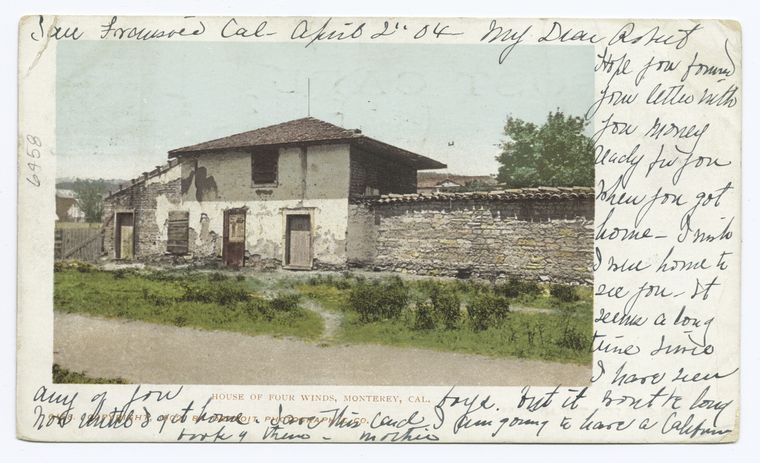
In the Back Yard of the House of Four Winds
It's always fun to come across an obscure piece of history in a photo and find out that a century later the place still exists and is in fact thriving. Such is the case with the House of Four Winds.
Our photo is a real-photo postcard, probably one of several depicting the old adobe which were sold as sourvenirs. If you Google the place, you'll find a lot of images of the front of the house, the street view, both old and new, because remarkably this early adobe has been saved and restored. It is located at 540 Calle Principal in old Monterey. However, a modern photograph from this perspective, would not be possible today (more on that in a minute).
At the time the house was built, in about 1835, Alta California was a territory of Mexico (which had just won its independence from Spain fourteen years earlier) and Monterey was the capitol of the territory. Thomas O. Larkin, the only American consul to serve in Alta California, developed a large piece of land and built several houses on it, including this one just a short distance from his own (as a non-citizen, he was not permitted to actually own land, but was able to obtain several land grants in the names of his children). The house originally had a weather vane mounted to the peak of its roof, supposedly the first such device in the territory, and so the local natives called the building "The House of Four Winds" (sometimes shortened to the Spanish name La Casa de los Vientos).
The house became the residence of Mexican Governor of California, Juan Bautista Alvarado. The building was only a year or so old when Alvarado led a rebellion against the distant central government in Mexico City. There was quite a bit of back-and-forth political turmoil, but Californio became a quasi-autonomous territory under Alvarado.
In 1846, Americans became more and more present in Monterey, and for a while the area was occupied by Americans. During this time, Alvarado used the building as a store.
In 1848, Mexico lost what hold they had on California in the Mexican-American War, and it became first a US Territory then a state. During the period of occupation by the Americans during the Mexican-American War, and immediately after, the house was used as a resident by Army Captain Henry "Old Brains" Halleck who served first as an aid to General Bennet Riley, the Governor-General of California Territory and then as military Secretary of State, which allowed him to be the Governor-General's representative at the California Constitution Convention, held in near-by Colton Hall in 1849; Halleck became one of the leading authors of the constitution of the new state. According to the California Military Museum, Halleck was the Convention's "brains because he had given more studious thought to the subject than any other, and General Riley had instructed him to help frame the new constitution." While records are obscure or non-existent, it is entirely possible that he could have done some of the writing of the Constitution in the House of Four Winds.
After California achieved statehood, the House of the Four Winds became the state's first Hall of Records with the establishment of the new County of Monterey, and the County Recorder, W. C. Johnson lived there.
In 1906, a number of prominent Monterey women joined together to form the Women's Civic Club (later renamed Monterey Civic Club) with the mission to acquire and preserve some Monterey's early adobe buildings before they succumbed to time and progress; the House of Four Winds was purchased in 1914 and was renovated, becoming the orgaization's clubhouse. Because of the age of the Archive's print and the presence of domestic animals, it is believed that our photograph was taken about the time the club acquired the building.
The restoration of the building was guided by Myron Oliver, at the time a leading expert on the history of early Monterey architecture and home decor. The facade has been restored to how it looked in the 1850s. He chose the furnishings carefully, and amongst the collection is the original desk from Colton Hall upon which the final draft of the Constitution was written.
As was noted earlier, our photograph could not be dublicated today, because in order to carry on their activites and yet not disturb their historic building, in 1953 the Monterey Civic Club built an addition onto the back of the building which now serves as a recreation and event hall, and a large Masonic Hall was built next door, as can be seen in the Google Maps view below.
More information on the house:
Our photo is a real-photo postcard, probably one of several depicting the old adobe which were sold as sourvenirs. If you Google the place, you'll find a lot of images of the front of the house, the street view, both old and new, because remarkably this early adobe has been saved and restored. It is located at 540 Calle Principal in old Monterey. However, a modern photograph from this perspective, would not be possible today (more on that in a minute).
![]() |
House of the Four Winds along with the Colton Hall on the
left and the Larkin House (which also survives) on the right.
Collection of the Monterey Civic Club
|
| Here's an old postcard view of the front, courtesy of the New York Public Library's Digital Collection |
In 1846, Americans became more and more present in Monterey, and for a while the area was occupied by Americans. During this time, Alvarado used the building as a store.
In 1848, Mexico lost what hold they had on California in the Mexican-American War, and it became first a US Territory then a state. During the period of occupation by the Americans during the Mexican-American War, and immediately after, the house was used as a resident by Army Captain Henry "Old Brains" Halleck who served first as an aid to General Bennet Riley, the Governor-General of California Territory and then as military Secretary of State, which allowed him to be the Governor-General's representative at the California Constitution Convention, held in near-by Colton Hall in 1849; Halleck became one of the leading authors of the constitution of the new state. According to the California Military Museum, Halleck was the Convention's "brains because he had given more studious thought to the subject than any other, and General Riley had instructed him to help frame the new constitution." While records are obscure or non-existent, it is entirely possible that he could have done some of the writing of the Constitution in the House of Four Winds.
After California achieved statehood, the House of the Four Winds became the state's first Hall of Records with the establishment of the new County of Monterey, and the County Recorder, W. C. Johnson lived there.
![]() |
| Glass plate negative, collection of the Monterey Civic Club |
The restoration of the building was guided by Myron Oliver, at the time a leading expert on the history of early Monterey architecture and home decor. The facade has been restored to how it looked in the 1850s. He chose the furnishings carefully, and amongst the collection is the original desk from Colton Hall upon which the final draft of the Constitution was written.
As was noted earlier, our photograph could not be dublicated today, because in order to carry on their activites and yet not disturb their historic building, in 1953 the Monterey Civic Club built an addition onto the back of the building which now serves as a recreation and event hall, and a large Masonic Hall was built next door, as can be seen in the Google Maps view below.
More information on the house:
- Calisphere has a series of early photo of the building, including a different cropping of our photo.
- Historic Monterey
- Old Monterey Foundation
- A History from the Centennial Celebration site
Subscribe to:
Posts (Atom)